
Why blended?
Blended English language courses offer you the advantages of classroom-based training integrated with the cost-effectiveness and flexibility of elearning, combining group learning, interactive self-study, and individual tutoring with qualified professional English teachers.

Objectives
"Integrating online study with lessons in person or by telephone with a qualified native English teacher, to learn better and with more flexibility."
The course integrates classroom or telephone coaching lessons with a qualified English language teacher with online study to improve the participant's application of new learning and their confidence in using English.
Blended learning courses are designed to improve the participant's use of English in all four language areas including comprehension and fluency.
How can a blended course help us?
- Effectiveness and productivity - optimize the learning process:
- more time available with the trainer for fluency practice and role-plays
- 360 degree learning and practice of each skill in a realistic business context
- more emphasis on applying new language.
- Flexibility - adapt the course to your work schedule and demands:
- shorter, more powerful learning sessions
- a personalized learning curve and adapting the pace to each individual's needs and abilities.
- Innovation - improve the training process:
- powerful and insightful progress monitoring and reporting
- higher student motivation and participation
- stimulating high-quality interactive content and classroom role-plays.
Learn more about the advantages and disadvantages of blended learning vs elearning vs traditional English courses with our comparison guide.
So how does it work?
"Expert teachers who were mindful of the objectives to achieve, so the exercises were targeted, and even enjoyable. 100% positive feedback, especially for the teachers."
Chiara Guarneri
E-commerce & Omnichannel Manager, Ermenegildo Zegna
Participants improve their fluency through applied simulations, conversation, and skills workshops with native English language trainers - in the classroom or by telephone, with virtual classroom or email support.
The elearning part of the learning cycle expands and enriches the participant's knowledge of vocabulary and grammar, and improves reading and listening comprehension.
Personalizing the learning cycle
We start with a Training Needs Analysis to recommend a personalized learning path, while providing the participant and the HR Department with measurable and documented progress.
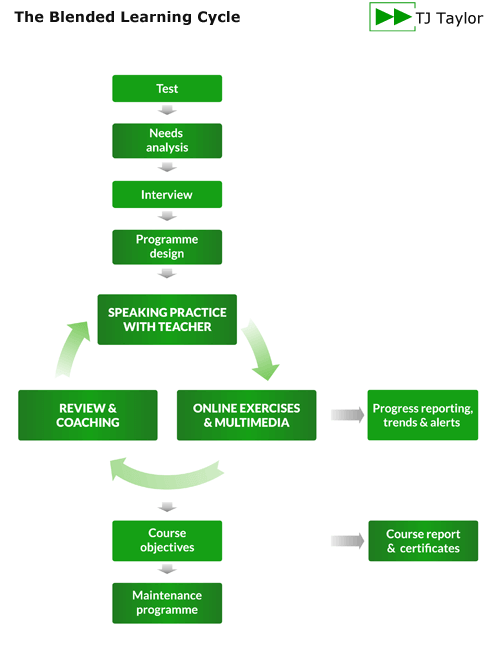
The first part of the course concentrates on testing, induction, and tailoring the course to the individual needs of each participant.
The second part focuses on feedback and support, interactive self-study, and applied practice with a teacher. This means every participant can:
- study at their own pace due to the flexibility of the elearning course
- practise and perfect new concepts with a qualified English teacher
- receive feedback and reminders from the lesson follow-up
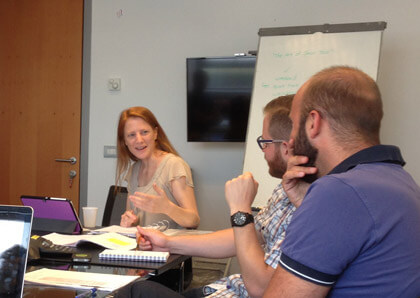
The sessions with the teacher reinforce and build confidence in the participant's use of English through role-plays, conversation and skills workshops.
The skills workshops can be adapted to deliver specialized client- or sector-specific training, as well as communication skills training on topics such as International Presentations, Powerful Communication, Negotiations, Working in International Teams, Legal Writing, etc.
Online learning
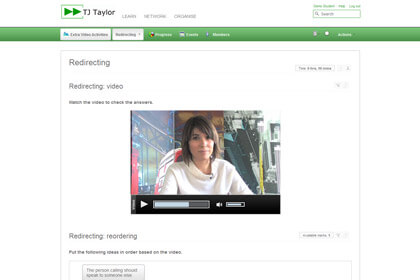
The elearning part allows the participant to choose which topics to focus on according to their individual strengths and weaknesses in comprehension, grammar, vocabulary, etc. Participants can also choose to specialize in Business English or General English, or a personalised combination of both.
To see some example online exercises, click on the image below:
Progress reporting
TJ Taylor provides regular, up-to-date reporting to the HR department and participants to monitor progress, resolve problems and improve learning performance - and so maximize your training investment.
Questions?
Our Blended English courses have been designed to deliver cost-effective, flexible and didactically rigorous language training.
If you would like to discuss how your company can communicate better across borders and cultures, or for a no-obligation quotation, call us on +39 02 4300 19075 or send us an email: